A Practical Guide for Every Stage of Your Business Journey
Let’s Be Real: Choosing Your First (or Next) Production Line Is Stressful
I still remember the first time I walked into a factory and watched an aluminum foil tray pop out of a mold. It took less than a second. The machine clunked, the tray dropped, and the stack grew taller before I could blink. That moment stuck with me—not because it was flashy, but because it was pure efficiency.
Fast forward a few years, and now I talk to business owners every day who are exactly where I was: excited, a little intimidated, and desperately trying to figure out which machine is actually right for them.
The truth is, there’s no “one size fits all” answer. A bakery in Beirut has completely different needs than a catering supplier in Dubai, and a startup testing the waters shouldn’t buy the same line as a factory pumping out millions of trays a month.
So let’s break this down—honestly, clearly, and without the sales fluff.
1、First, What Exactly Does an Aluminum Foil Tray Production Line Include?
Before we dive into models, let’s get on the same page about what you’re actually buying.
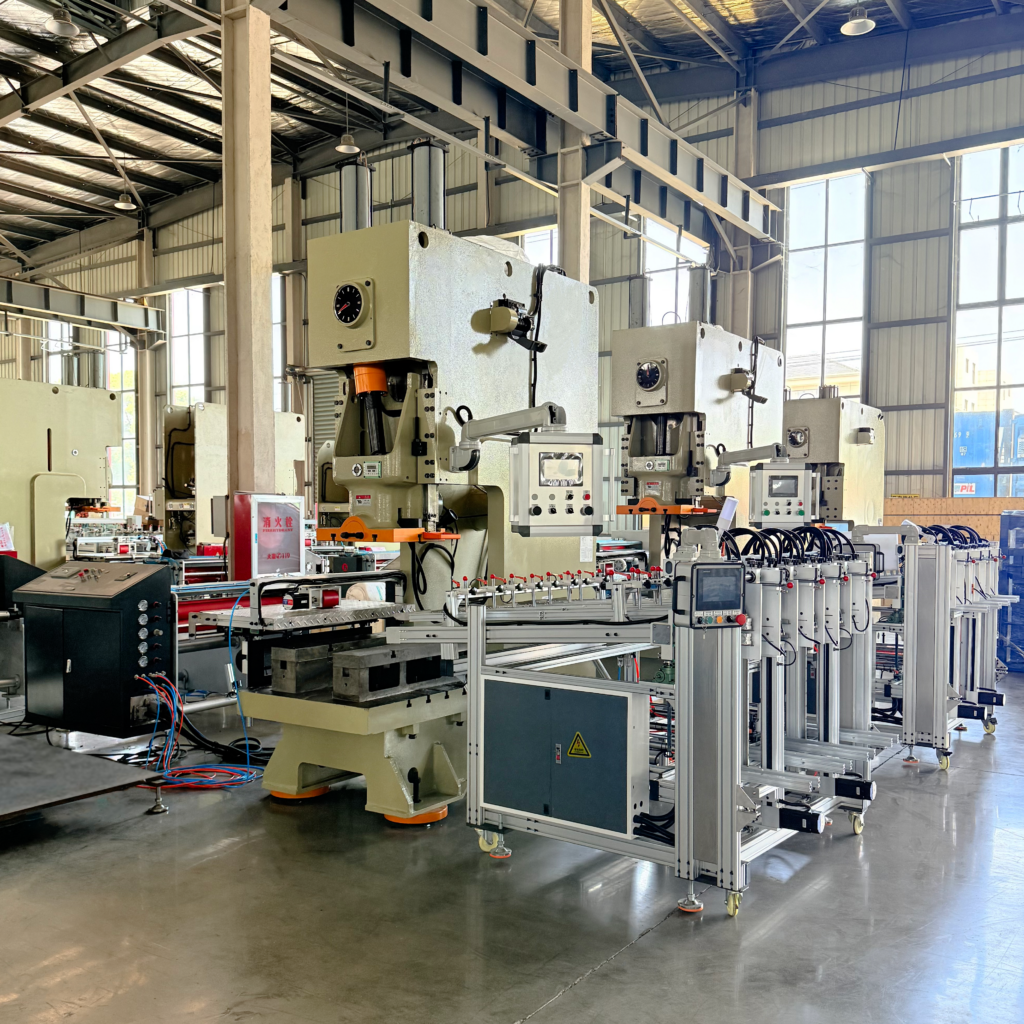
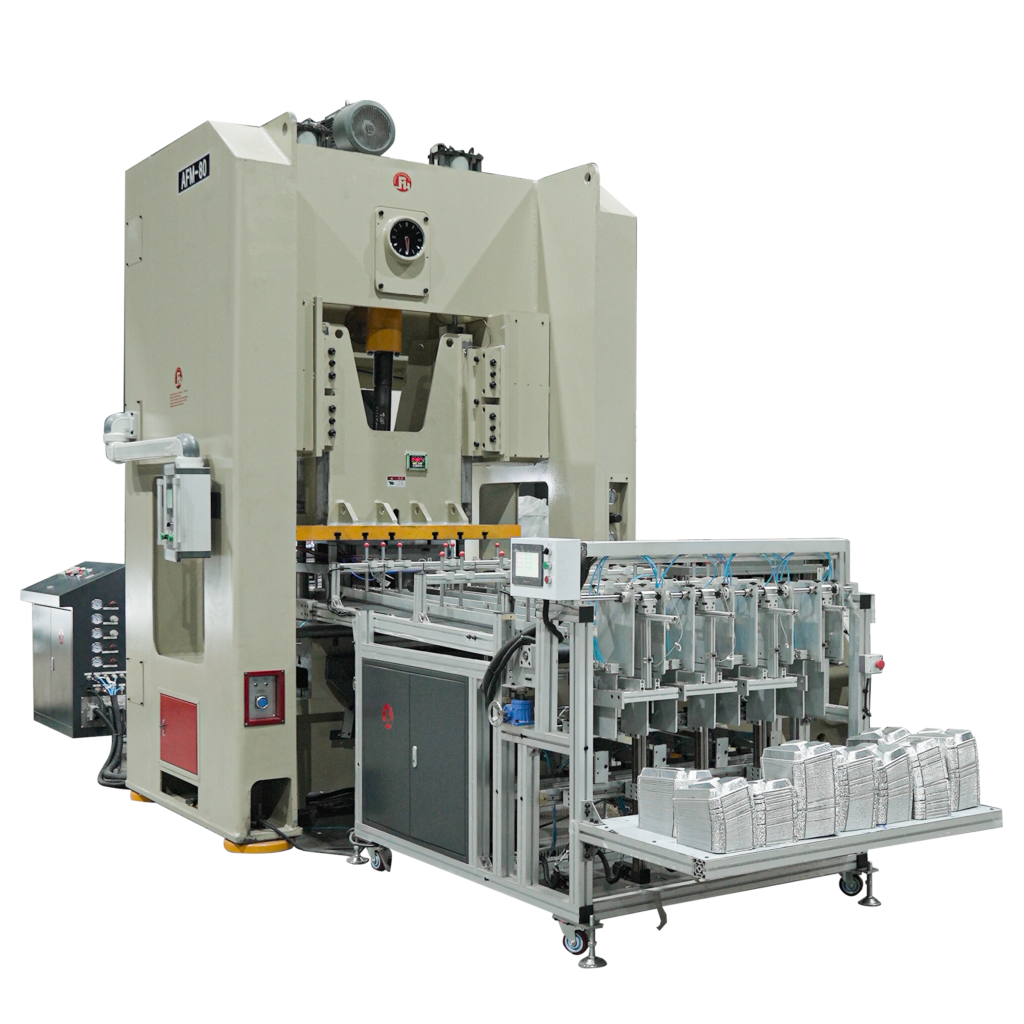
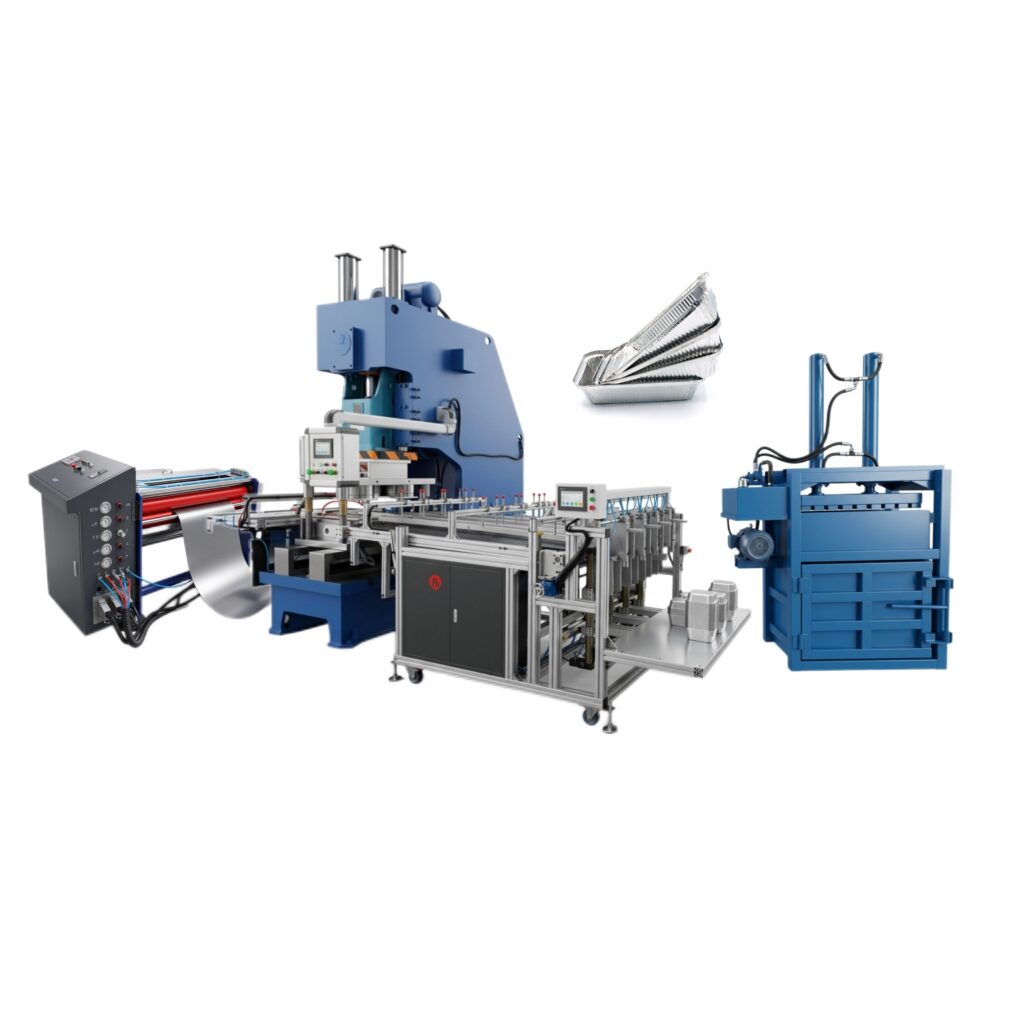
A complete production line isn’t one machine—it’s a team of machines working together. Picture this:
- The Unwinder/Feeder – This holds the giant roll of aluminum foil and feeds it into the press smoothly. Our SL series feeders use double motors (Italian design) to prevent slipping and wrinkling. Precision: ±0.1mm.
- The Press (the heart of the line) – This is where the magic happens. A high-speed pneumatic press punches the foil into tray shapes. We use WODET (a publicly traded company) press bodies with a high-temperature tempering process—meaning the frame won’t deform over decades of use.
- The Stacker – After the tray is formed, it needs to be stacked neatly. Manual stacking causes dents, contamination, and headaches. Our automatic stackers (2 to 5 lanes) do this at up to 65 trays per minute, without human hands touching the product.
- The Scrap Baler – The leftover edge trim gets compressed into tidy bales for recycling. You actually make money back from selling the scrap aluminum. One baler can serve three production lines.
Now let’s talk about the actual press models—because this is where the real decision-making happens.
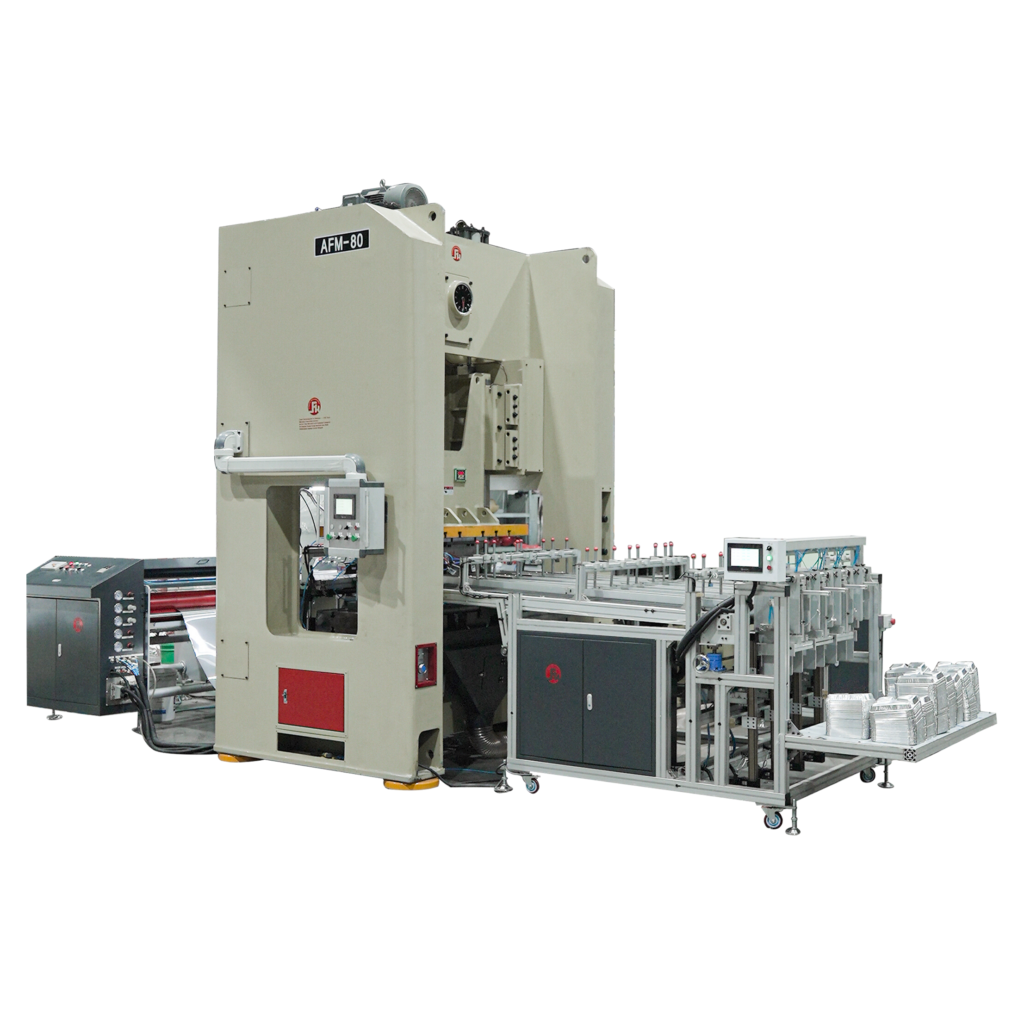
2、Your Complete Model Guide: Which One Fits Your Business?
AF-40AT: The “I’m Just Getting Started” Option
Who it’s for: Startups, small bakeries, or anyone testing the market with a limited budget.
Think of it like this: If you’re opening your first coffee shop and learning how to make espresso, you don’t buy a commercial 3-group machine. You buy something reliable, simple, and affordable. That’s the AF-40AT.
What it does:
- Press force: 40 tons
- Max tray depth: 50mm
- Output: 40–80 trays per minute (one cavity)
- Throat depth: 260mm
- Bed size: 720mm × 500mm
- Max material width: 500mm
- Motor power: 5.5KW
- Weight: 3,500 KG
Mold cavities: 1 cavity standard
Daily production estimate: Running at 60 trays/min for 8 hours → roughly 28,800 trays per day.
The real talk: This machine is perfect for a single product—say, a standard round tray for a local bakery chain. It’s open-frame, easy to maintain, and doesn’t require a massive factory floor. If you’re unsure about demand, this is a low-risk entry point.
The catch: You’re limited to one cavity, so your output is capped. That’s fine for year one. But if you grow fast, you’ll outgrow it.
AF-45AT: The “I Want Room to Grow” Option
Who it’s for: Small to medium businesses that have some orders lined up and want a little more flexibility.
What it does:
- Press force: 45 tons
- Max tray depth: 80mm
- Output: 40–80 trays per minute (one cavity—or two if you upgrade)
- Throat depth: 450mm
- Bed size: 800mm × 900mm
- Max material width: 800mm
- Motor power: 7.5KW
- Weight: 5,000 KG
- Wait, let me double-check: the directory says 45AT at 5,000 KG in the main table on page 12.
Mold cavities: Can support 1 or 2 cavities
Daily production estimate (2 cavities): Running at 70 trays/min × 2 = 140 trays/min → roughly 67,200 trays in an 8-hour shift.
The real talk: This is one of our most popular models for a reason. It bridges the gap between entry-level and serious production. The bigger bed (800×900) gives you more room for larger trays, and you can run two cavities if you want to double output without doubling your machine investment.
Who should buy this: A catering supplier handling 5–10 restaurants. A regional distributor starting to build a brand. Someone who’s already proven demand and needs to scale without jumping to a 60-ton machine.
AF-63AT: The “Workhorse That Won’t Quit” Option
Who it’s for: Established businesses with consistent orders across multiple tray sizes.
What it does:
- Press force: 63 tons
- Max tray depth: 90mm
- Output: 40–70 trays per minute
- Throat depth: 600mm
- Bed size: 1000mm × 1200mm
- Max material width: 1100mm
- Motor power: 11KW
- Weight: 8,800 KG
Mold cavities: Can support 1, 2, or 3 cavities (the main table says SG-3, meaning three-lane stacker)
Daily production estimate (3 cavities): Running at 60 trays/min × 3 = 180 trays/min → roughly 86,400 trays in an 8-hour shift.
The real talk: This is where things get serious. The 63AT gives you three cavities—meaning three trays come out with every press. That’s a huge jump in efficiency. The throat depth is 600mm, so you can make deeper trays (think: lasagna pans, roasting trays, deep-dish containers).
The bed size is 1000×1200, giving you real estate for larger dies. If you’re supplying hotels, airlines, or institutional kitchens, this machine is your entry ticket.
The catch: This machine is heavier (8.8 tons) and requires a solid floor and proper power supply (380V, three-phase). But the ROI is real—three times the output with only slightly higher operating costs.
AF-80AT (Open Frame) & AF-80T-H (Heavy-Duty): The “Serious Money-Maker” Options
Who it’s for: High-volume manufacturers with multi-shift operations.
80AT (Open Frame)
- Press force: 80 tons
- Max tray depth: 130mm
- Output: 50–78 trays per minute
- Throat depth: 650mm
- Bed size: 1000mm × 1300mm
- Max material width: 1200mm
- Motor power: 11KW
- Weight: 9,200 KG
Mold cavities: Up to 5 cavities
80T-H (Heavy-Duty)
- Press force: 80 tons
- Max tray depth: 130mm
- Output: 40–68 trays per minute
- Throat depth: 750mm
- Bed size: 1000mm × 1500mm
- Max material width: 1400mm
- Motor power: 11KW
- Weight: 15,300 KG
The real talk: The 80-ton models are where we start to see real industrial capacity. The Open Frame version is more accessible; the Heavy-Duty version (closed-frame) is for people who plan to run two or three shifts a day for the next 20 years.
The closed-frame design means less flex during high-speed operation. It’s more rigid, more precise, and more durable. If you’re planning to be in this business for the long haul, the 80T-H is worth the premium.
Daily production with 5 cavities (Open Frame): 70 trays/min × 5 = 350 trays/min → roughly 168,000 trays in 8 hours.
The catch: You need serious material handling. Five cavities means you’re feeding a lot of aluminum, and you’ll want the SL-1200 feeder to keep up. You’ll also need a reliable scrap baler, because 168,000 trays produce a mountain of trim.
AF-130T: The “We’re a Real Factory Now” Option
Who it’s for: Major manufacturers supplying national or regional distribution chains.
What it does:
- Press force: 130 tons
- Max tray depth: 140mm
- Output: 40–68 trays per minute
- Throat depth: 800mm
- Bed size: 1650mm × 1000mm
- Max material width: 1600mm
- Motor power: 17.5KW
- Weight: 16,500 KG
- Mold cavities: Up to 6 cavities
Daily production estimate (6 cavities): 60 trays/min × 6 = 360 trays/min → roughly 172,800 trays in 8 hours.
The real talk: The 130T is a beast. It’s got the largest bed in the lineup (1650×1000), which means you can run huge trays or run six smaller trays at once. The closed-frame design handles the 130 tons of force without breaking a sweat.
Who buys this: Companies that have already established a brand and are supplying to retailers like Carrefour, Lulu Hypermarket, or airline catering services. The output is staggering—nearly a quarter million trays per day if you run two shifts.
The catch: You need serious infrastructure. 16.5 tons of machine, 17.5KW motor, 0.6MPa air pressure, and a forklift to move the dies. This isn’t for tinkering; this is for running a business.
AF-200T: The “We’re the Market Leader” Option
Who it’s for: Large-scale manufacturers with multi-product, multi-shift operations.
What it does:
- Press force: 200 tons
- Max tray depth: 140mm
- Output: 40–68 trays per minute
- Throat depth: 800mm
- Bed size: 1650mm × 1000mm
- Max material width: 1600mm
- Motor power: 17.5KW or more
- Weight: We don’t have exact KG listed, but expect 18,000+ KG
Mold cavities: Up to 6 cavities
The real talk: The 200T is our flagship for tray production. Two hundred tons of force—enough to punch through thick aluminum, create deep-draw trays, or run complex multi-cavity molds with embossed logos.
Who buys this: Only the largest players. Think: national food packaging companies, export-oriented manufacturers serving European and GCC markets, or businesses that have 5+ production lines running simultaneously.
The catch: If you’re reading this and thinking “maybe I should buy the 200T just to be safe,” don’t. Buy what fits your current demand, with a little room to grow. Overbuying capacity ties up capital and increases operating costs. Start smaller, prove your demand, then scale.
3、Quick Comparison Table: See It All at a Glance
| Model | Press Force | Max Depth | Output (per min) | Cavities | Daily Output (8h) | Weight | Best For |
| AF-40AT | 40T | 50mm | 40–80 | 1 | ~28,800 | 3.5T | Startups, testing new products |
| AF-45AT | 45T | 80mm | 40–80 | 1–2 | ~67,200 | 5.0T | Growing businesses, 2-cavity upgrade |
| AF-63AT | 63T | 90mm | 40–70 | 1–3 | ~86,400 | 8.8T | Established, multi-cavity production |
| AF-80AT (Open) | 80T | 130mm | 50–78 | Up to 5 | ~168,000 | 9.2T | High-volume, diverse tray sizes |
| AF-80T-H (HD) | 80T | 130mm | 40–68 | Up to 5 | ~163,000 | 15.3T | 24/7 operations, extreme durability |
| AF-130T | 130T | 140mm | 40–68 | Up to 6 | ~172,800 | 16.5T | National distribution, heavy-duty |
| AF-200T | 200T | 140mm | 40–68 | Up to 6 | ~172,800+ | 18T+ | Largest manufacturers, export scale |
4、Beyond the Machine: What Else Matters?
The Feeder Matters More Than You Think
A press is only as good as its feeder. Our SL series feeders (SL-500 through SL-1600) use a double-motor system that prevents slipping—a common headache with cheaper feeders. The Italian-inspired design means the foil spreads evenly, with no wrinkles, no uneven feeding, and no random jams.
Precision: ±0.1mm. Speed: up to 200 m/min. That’s important because even a 1mm error over 100,000 trays adds up to a lot of waste.
Stackers: Your Quality Control
Remember the old days when workers would manually stack trays? Those days are over. Our stackers (2 to 5 lanes) automatically count, stack, and output trays without human contact. This isn’t just about labor savings—it’s about food safety. Trays that touch hands are trays that can carry bacteria.
Stacker specs:
- 2-lane: 1KW, ~300KG, 65 trays/min
- 3-lane: 1.5KW, ~350KG, 65 trays/min
- 4-lane: 2KW, ~400KG, 65 trays/min
- 5-lane: 2.5KW, ~450KG, 65 trays/min
The Little Things: Mold Quality
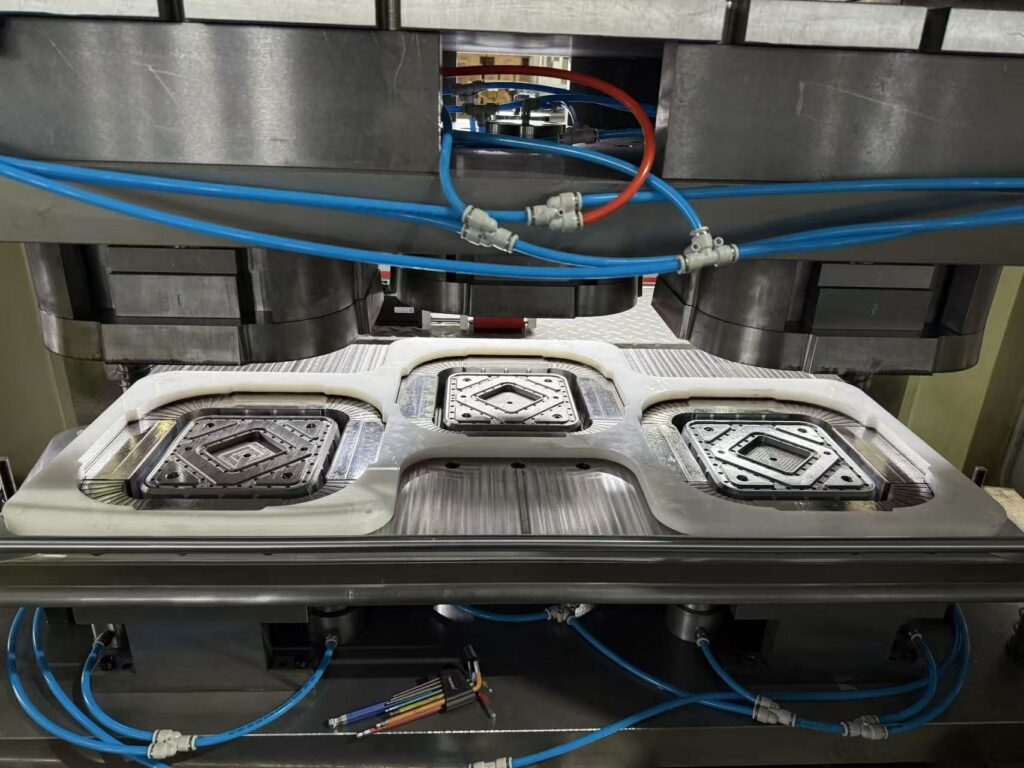
If you’re going to invest in a line, invest in the mold too. We use DC53 steel from Japan (harder, more wear-resistant than standard steels), with slow wire EDM machining and deep cryogenic treatment. The result? Molds that last years, not months.
One real-world example: A customer in Saudi Arabia was using generic molds that wore out every 3 months. They switched to our DC53 molds—the same mold is still running 18 months later.
5、The “Boring” Stuff That Actually Matters
Power Requirements
- 40AT–63AT: 380V/50Hz, 3-phase, 5.5–11KW
- 80T and above: 380V/50Hz, 3-phase, 11–17.5KW
- Custom transformers available for countries with different standards
Air Pressure
- All models: 0.5–0.6 MPa
- You’ll need a decent air compressor. Don’t skimp on this—poor air quality leads to inconsistent stacking and misfeeds.
Space Requirements
| Model | Floor Space Needed |
| 40AT–45AT | ~5m × 3m |
| 63AT | ~6m × 4m |
| 80AT/130T | ~7m × 5m |
Our 5-Year Warranty: Why It Matters
Here’s something I’m genuinely proud of: every press frame we make goes through a high-temperature tempering process. This removes internal stress from the steel—meaning the frame won’t warp or twist over time.
Most of our competitors skip this step. Their machines might be cheaper upfront, but after 5 years of heavy use, the frame starts to deform, and the trays start coming out uneven.
Our machines? We give a 5-year warranty. Not because we’re brave—because we know our frames won’t crack, won’t bend, won’t age poorly.
6、A Story: How Two Customers Made Very Different Choices
Customer A: A small business owner in Jordan, starting a catering supply company. He bought the AF-40AT—just one cavity, simple operation. His reasoning: “I have 20 restaurants as potential clients. I don’t need 10,000 trays an hour. I need 3,000 good trays a day.”
He started with one shift. Six months later, he added a second shift—same machine, double the output. Two years later, he ordered an AF-63AT with three cavities and moved the 40AT to a secondary line. He grew into his investment, instead of overpaying upfront.
Customer B: A UAE distributor who had already secured contracts with two hotel chains and an airline caterer. He needed large quantities immediately. He bought the AF-80T-H, running 5 cavities, 18 hours a day across two shifts. For him, downtime was the enemy—the closed-frame design gave him the durability to run hard and run often.
Both customers are profitable. Both chose the right machine for their stage. Both avoided the trap of buying “too much” or “too little.”
7、So… Which One Should You Choose?
Here’s my honest advice:
- If you’re testing the market or just starting: Buy the AF-40AT. It’s affordable, reliable, and easy to learn. When you outgrow it, sell it and upgrade. The depreciation is minimal.
- If you have a stable order book (like 5–10 regular clients): Buy the AF-45AT with two cavities, or the AF-63AT with three cavities. The extra cavities give you production capacity without buying a second machine.
- If you’re scaling fast (20+ clients, multi-shift potential): Look at the AF-80AT Open Frame or the AF-80T-H. The Open Frame is good for standard production; the Heavy-Duty is for 24/7 operations.
- If you’re a major supplier (national distribution, exports): The AF-130T is your sweet spot—6 cavities, enormous output, and extreme durability.
- If you’re the largest player in your region: The AF-200T exists for you. But call us first—we’ll do a site visit, analyze your needs, and make sure the 200T is actually the right fit.
8、Final Thoughts: What We Do Beyond Selling Machines
Look, I could leave you with the specs and say “good luck.” But that’s not how we operate.
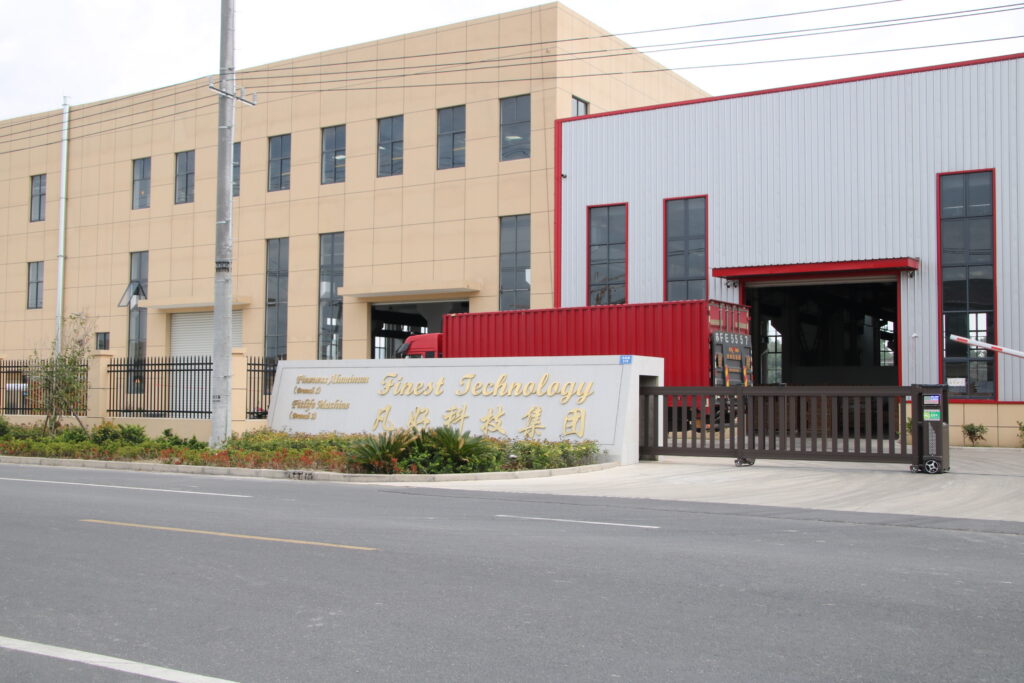
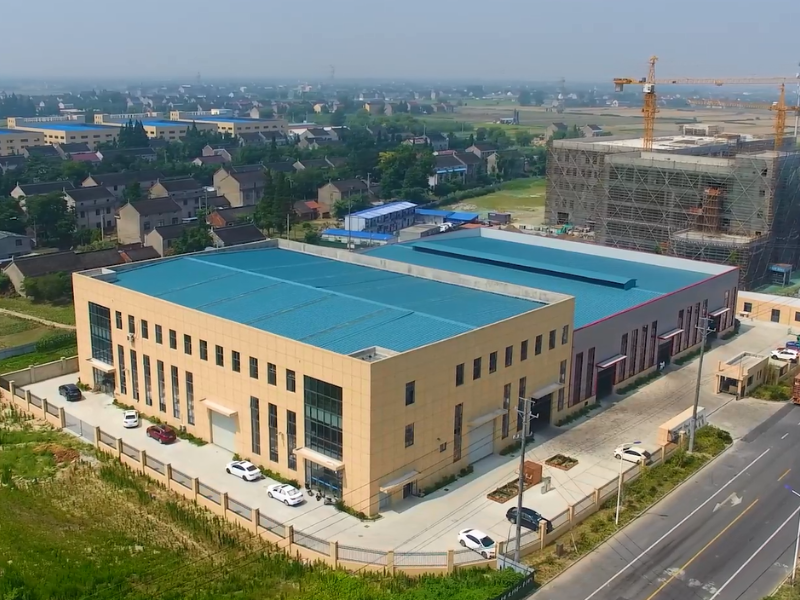
When you buy from Jiangsu Finest Technology, you get:
- Factory floor layout assistance – We’ll tell you where to put each machine, how to wire the power, and where to set up your scrap collection.
- Vendor referrals for consumables – Need a good oil supplier? A reliable foil roll vendor? We share our network.
- 20 years of production experience – We’ve been making aluminum foil products for two decades. We know the shortcuts, the mistakes, and the best practices.
- 5-year warranty – Because we believe in what we build.
9、Ready to Talk?
Every business is different. I’ve given you the specs, the comparisons, and the honest opinions. Now it’s time for a real conversation.
Tell me:
- What trays are you planning to make? (Size, depth, quantity)
- What’s your current order volume? (Monthly or daily)
- What’s your budget range?
I’ll give you a tailored recommendation—not just a model number, but a plan.
P.S. — Still not sure? I’ve helped dozens of business owners choose their first line. Some of them called me back two years later to upgrade. Some of them ordered three more lines. None of them told me they bought the wrong machine. Let’s make sure you join that list.